 |
||||||
 |
Final Act
“Ah, yes. Mr. Richard.” The nurse at the station desk smiled. “Already he is everybody’s favorite.” The sight of you was a shock and relief. It had only been three months since we’d all flown in for your 95th birthday. You were thinner now. Your pale body limp against the white sheets. But better than I had imagined. When the last flight of the day had been canceled the day before, I’d wondered if I would make it. When we stepped around the curtain, you smiled with recognition, raised a weary arm. “Well, look who’s here!” You fumbled to grasp our arms, clucking in disbelief. “Oh, you didn’t need to come all this way,” you scoffed. “Of course we came.” I kissed the top of your head, where your thin, white hair had been combed carefully to the right side instead of the usual left. We pulled up chairs, flanking your bed. You looked at me, then Beth with such delight. Unexpected guests at a party. You chuckled. Enjoying your altered state like the early high of a good bourbon. You must have known what our presence meant. Recognized the sadness glistening in our eyes. But if you did, you wouldn’t let on. Optimism and denial were the creeds you lived by. The show must go on to the very end.
Every so often, you would yelp in pain, then go rigid and quiet. The external defibrillator they’d connected to your heart was shocking you back to life. Did you even know? It was painful to watch. Nurses pushed us aside while they tended to you. Each time, you recovered more slowly, weakened, less present. Oh, Dad. You had a DNR. Why did you let them do this to you? I was glad for the time with you, but you’d been enduring this torture for 24 hours. The doctors had been waiting for us to get there and make a decision for you. Were you afraid of dying? Is that why you told them to do everything they could? Or was your usual overactive positivity convincing you that this was just a blip? You’d be back on your feet in no time. Make it to that 100th birthday party we’d promised you. “I just need a new battery,” you said. And it was true. Your pacemaker battery had died. When the surgeon finally returned my calls, he insisted it was a simple surgery. Could be done that afternoon. He had a slot reserved. Beth and I needed time to think. It was your nurse who confirmed the whole picture for us. This new dementia was not a drug high. It was permanent, brought on by the anesthesia of the initial surgery, and would likely be worsened by a second. You would not be able to return to your assisted living home, with the patio you loved. The dogwood tree with the bird feeder you diligently filled with the seed Beth ordered from Amazon. The caregivers who loved you in spite of your disdain of Bingo and crafts. We would have to move you into a memory care facility. Did you guess what we were talking about so urgently in the hallway? Did you see our distress when we returned? Probably not. Even sober you were pretty oblivious to emotions around you. It felt like a betrayal though. We couldn’t talk to you honestly about it, because you were ready to party. Of course you would insist on the battery replacement, so we could all go camping with your dead wife and son. You would poo-poo any talk of memory care and limited functionality. Because you’d be FINE. You were always fine. And it was true. You were in great shape for 95. Only went to the doctor for your annual exam, which you always reported as perfect. You never even got a cold. Or Covid, even though five people in your place died that first week of lockdown. You probably would live to 100 with a fresh pacemaker battery. But in what condition? You saw Mom in the later stages of Alzheimer’s. You were kind and full of pity, but you swore that would never be you. Said you’d do yourself in before you ever went to a nursing home. You gave our cousin power of attorney over your health matters, because you said she wouldn’t be afraid to pull the plug. But Murray was handing the reins to us. Meanwhile, that goddamn defibrillator was ravaging your fragile body. We consulted with the boys, neither of whom could pull away from their demanding jobs long enough to travel. We all agreed, and as the oldest sister, I made the call. Beth nodded, eyes brimming. The surgeon was irritable, dismissive. But the nurse hugged us both. If on some level you knew, I hope you understood. I hope you remembered what you’d always said you wanted. It was hours still before they disconnected the dreaded defibrillator. You joked with the nurses, asked for a six pack. They smiled at your harmless flirting. Maybe you thought you were getting better when they removed your IV and wires and wheeled you upstairs to the hospice ward. A big room, all to yourself. They’d taken out the other bed and brought in a second couch. It was spacious and comfortable, and as we got settled, you raised your head and looked around with renewed energy. “Nice upgrade! Who’d you bribe?” You were hungry and they brought you a dinner tray. You worked through it methodically. Cut the chicken breast yourself. Alternating bites of chicken with mashed potatoes and gravy, ignoring the green beans as usual. You buttered the roll before each bite, scraped the pudding cup clean. Sucked milk with a straw to the noisy finish. I was astounded by your vigor and appetite. Maybe you weren’t dying after all. You were so calm and happy. We tucked you in for the night and went to a nearby hotel, stopping for fast food on the way. The next morning, a nurse met us at your door. You’d had a “bad night,” she said. Were agitated and combative. Had fought with the aides trying to help you. They’d sedated you. No promises on when or whether you’d wake. We stayed in the room with you all day, taking turns to step outside and call our spouses or text the boys. Your lungs were starting to fill and when your gurgling gasps became unbearable, we’d press the red button and a nurse would suck out fluid with a tube. An uncomfortable procedure, but it helped. This was the hard part, watching you struggle. Stroking your arm, your head. Begging the nurses for more morphine. “Ironic, hm?” I whispered to Beth over your sleeping body, quiet now. She raised an eyebrow. I didn’t need to say more. We both knew that our attentive devotion was more than you deserved. “There were times I wondered if we’d even get that.” I’d tried not to care, all those years you were gone. If someone asked me if my dad was still alive, I’d shrug. “Who knows?” But it doesn’t really work that way, does it? Or maybe it does. Did you stop caring? Did you only remember us after Vicky died? For most of my adulthood, I had a recurring dream. I’d see you in a crowd somewhere. A city sidewalk. An open-air market. An outdoor concert. I’d catch a glimpse of your face, jolting me like lightning. Then I’d track your wavy, black hair bobbing through the crowd away from me. “Dad!” I’d shout, pushing through stiff elbows, unyielding shoulders. “Dad! Dad!!” I’d yell so loud in my dream, the taste of that word in my mouth unleashing what felt like a life of longing. I’d always wake before you heard me. My chest clenched with unshed tears. My jaw and throat rigid with silent screaming. “I’m glad, though,” Beth said. “To be here. To have this.” She felt for your arm under the sheet, gave a squeeze. “I know. Me, too.” “Fifteen years I didn’t think we’d have.” “Does it make up for the 30 we didn’t?” The tears in her eyes made me regret bringing it up. “That never really goes away, does it?” She shook her head. When Beth went for food, I scooted the chair closer to you. This was my chance to say out loud whatever it was I needed to say. I’d played out this scenario many times in my head over the years, sometimes railing, sometimes tender. Asking questions I knew you’d never answer. Waiting for apologies and regrets I knew I’d never hear. But the voices in me were quiet. Your fingers twitched and I took your bony hand in mine. It was cold. With my other hand, I touched your face – so pale, so old, and yet the same. “I love you, Dad,” I whispered, my voice cracking. Could you hear me softly crying? A moment later, you opened your eyes and looked into mine. “I love you,” you said, then fell back into sleep. When Beth came back into the room, I was elated. I almost didn’t tell her the “love you” part, because I didn’t want it to be just me. She needed it even more than I did. We both stayed by your side after that, and I silently urged an encore. It came later in the afternoon. You opened your eyes, gazed up at each of us and smiled. “Kisses,” you whispered and pursed your lips. I admit, I hesitated, looking at those dry crusty lips. But we both bent down to kiss you lightly. You squeezed our hands and said, weakly but firmly, “I love you both.” This was the moment I’d come there for. Nothing else mattered. That and the tearful look Beth and I shared. You could die now and I would feel complete. But there were still the boys… Chris called before dusk, and you opened your eyes when you heard his voice on speaker. We held the phone to your face and you came to life again. You asked about his work. Listened attentively as he assured you that you would get better. But he also talked about how much he loved you. And I was grateful for that. No need to bring up ingrained injuries and disappointments. He got to hear you say you loved him. He said it back. That’s all that mattered. In the hallway, Chris asked us how he could help. “Write the obituary,” I said. That would be trickier than any Father’s Day card we’d had to navigate. I knew he’d tackle it with the same solemn intention he gave those Supreme Court briefs he was always working on. By the time David called, you’d slipped further away. Your words were garbled and few. But you listened with your eyes closed. You smiled. Said, “Love.” Nodded and smiled when he said he loved you, as if you’d known all along that was there, under all the hurt and bitterness. We relayed each response to David. I wish you’d been more present for him. He always got the shortest stick in that regard. But he said his goodbye, which was the important piece for both of you. The nurses brought sheets and pillows, and Beth and I made up the couches, were just settling in for the night, exhausted, when you suddenly came alert, wide awake. “What should we do?” you asked. As if the night were young and we could pull together a game of charades. Beth and I lifted ourselves out of bed and dragged the chairs back to your bedside. I was so tired, part of me wanted to tuck you in tight like a little child and tell you it was sleeping time now. But this was a stunning shift, and I knew it was temporary and final. The “rally” before the end. We would stay awake as long as you wanted. We talked of old times. Skipping over the middle years, we reached for happy childhood memories. There were many. You’d been a good dad, until the divorce and Vicky took you away from us.
I pulled out my iPad and accessed online photo albums I’d created. Several of our family when you were still with us. One album of you as a child and all your ancestral photos. You looked at each one attentively, smiled and nodded as we narrated with our memories. But it was your childhood photos that really held you. You and your brothers. Your parents. You studied each one, lingering. Your voice grew stronger as you recalled events, chuckled about antics and adventures. Marveled at your mother’s beauty. When you finally wearied and closed your eyes, you never opened them again. Your last bedtime story. We were awed by the miracle of it, suspended in the silence between us. Five more days you lay unconscious. Mostly you were still, breathing more easily with regular morphine and occasional suctioning. Not responsive to our words or touch. But I think you were aware of us. We wiped your seeping eyes with wet cloths, smeared Vaseline on your cracking lips. We didn’t leave the room that next day, thinking “any minute now…” The longer you hung on, the less eminent it felt. The second day, Beth and I went to your place to sort out things to save. Trying to get a box out of the top of your closet, I fell and broke my arm. Yeah, you missed that whole drama. You would have laughed at the absurdity of it. “What a silly mess,” you would have said when I showed up in a huge splint and sling. The nurses and aides fussed over me. Brought us extra dinner trays and pillows. It’s like the mortar of stoicism melted, collapsing the walls that propped us. We didn’t cry. We laughed. Giggle fits that neared hysteria. We couldn’t stop and even pillows couldn’t muffle it. Twice a nurse opened the door to make sure we were alright. As soon as the door closed, something would set us off and we’d start up again. It’s always been like that with Beth and me. No one can make me laugh like she does. I didn’t worry about being inappropriate, because I knew you were listening and loving every bit of it. You cherished our closeness. Once when we visited, just the two of us, we tried to get you out to do things – go to a movie or play, a bookstore, dinner out. But you were content to hang out in the Airbnb with us. You rested in a cozy chair with your eyes closed. Said listening to us talk and laugh was music to your ears. You didn’t want to miss a minute of it. I think that’s why you wouldn’t die. You didn’t want to miss a minute of the party. You hung on for so long, you baffled the doctors. After four days without food or water, they said it should be any time. But the hospital social worker brought us brochures for nursing homes. Said we had to prepare for discharge in 36 hours. Medicare wouldn’t pay for more. I don’t even know if you wanted to see Vicky again. From what I’d heard, your marriage was tumultuous, battered by chronic breakups and alcoholic binges. But you adored Rich. You were so pleased to introduce us at your 80th birthday party. As I shook his hand, I studied his face, then looked at Beth’s. “He has our eyes!” I exclaimed. Green and almond-shaped. A connection I hadn’t even considered. We all laughed at the wonder of it. He was 32 then. I saw him only one other time before he died suddenly at 34, riddled with hidden cancer. Then it was just us. The family you left behind. A nurse suggested you were holding out for someone. Was there another person you needed to say goodbye to? Some unresolved issues? Unresolved issues. Ha. There were plenty of those, for sure. A whole mine field of them. After Vicky died, you resurfaced. No apologies, no remorse. Just there, professing love behind a grim face. I was cautious at first, distrusting, but I let you in. We all did to some degree. Somehow love and hope resurfaced, won out over resentment. Bubbling up through the sludge of mixed emotions that sat heavy in each of us for so long. But we never really talked about it. Just got good at dodging the mines. I think I was the only one who even tried to talk to you in a real, honest way. That road trip we took back in the beginning, remember? You wanted to go see Beth in Texas, then David in New Orleans. A bit too soon, in retrospect. They were both courteous, if edgy. But Amy was outright hostile. Shot daggers at you from every angle. Snide remarks as soon as David left the room. It was so uncomfortable we left early, and you were dismayed. Couldn’t understand what had happened. I was driving then, and I kept my eyes on the road while I talked, words finally tumbling. “You left us, Dad. You can blame the divorce. Blame us kids for siding with Mom. For being stiff and somber at your surprise courthouse wedding. Sullen at that first awkward Christmas. Not happy enough about Vicky’s pregnancy. But we were your kids. You were the Dad. You should have put your own feelings aside and acknowledged ours. At least given us some time before you disappeared on us.” I glanced over to see if you were listening. “You’re right.” You nodded, mouth downturned. “I should have.” “Chris and I were launched, more or less. But David was 14. He needed you.” “I know that. Vicky and I tried to get custody of him. A boy needs a father.” “You lavished him with gifts and promises, and when he chose to live with Mom, you shut the door on him. As if you’d divorced him, too. What does that do to a 14-year-old kid? Amy knows. That’s why she can’t stand to look at you.” “And Beth. She was 18. Too old for custody or child support, so you just ignored her. Like she wasn’t even there. You wouldn’t help with tuition, so she lived at home and went to the local college.” The three of them created a new mini family in a new city. Refugees bonded by heartbreak. When I’d visit, I envied their closeness, their inside jokes and ease of affection. They propped up Mom like loyal sentries, using humor and distraction to keep her afloat. I looked over at you, staring out the car window without seeing. There were tears in your eyes. “I was a son-of-a-bitch,” you said quietly, as if the realization had only now occurred to you. I let that settle with you. It was minutes before you spoke again. “I don’t know if I can fix this. I don’t know if I’ll ever see him again.” Your sadness eased my fury. My voice was quiet, but firm. “You need to say you’re sorry.” You took a deep breath and slapped your thigh. “I’ll write him a letter.” And you did. Worked for days on it. Ran it by me and I said, “Try again. Dig deeper.” The next was better. Maybe it helped. Enough that David showed up for your 90th birthday, and again for your 95th. I only wish I’d said, “Write to Beth, too.” Because here now, at your side, I could still see so much hurt in her. Once again, the appeasing middle kid had been ignored. But here we were, at your death bed. Issues were as resolved as they were ever going to be. Over the last 15 years, we came to enjoy a relationship with you we’d never expected to have. Tentative at first. Each visit, each phone call thatching a trust that led to forgiveness. Forgiveness that led to peace. I will always be grateful for that. I hope you heard us tell you that David was flying in from New York the next morning. Maybe that gave you what you needed to finally let go. Or maybe it was being left alone at last, party over, because after four nights of hospital couches with a broken arm and torn shoulder, I begged for a hotel bed. Maybe your body could simply not defy death any longer. We’d only been asleep a few hours when the nurse called. They promised it was a peaceful slip away, and I hoped that was true. I called David and caught him at JFK, getting ready to board. “Don’t come,” I said. “We’ve both got tickets out this afternoon.” It would have been nice, though. To have one night, just the three of us, pulling David in closer. Beth and I drove over immediately. The night was still, and cold. It held us suspended in a quiet dream. The Christmas lights in front of the hospital were inappropriately festive. The doors were locked. Who locks a hospital? We found a janitor to let us in. On the ward, the nurses we’d come to know by name nodded at us, grim smiles, sad eyes. I know you loved me. You said it all the time. As if each utterance erased another day of absence. You loved each of us in your limited, flawed way. I felt it then. Like clouds parting to reveal a moon so full and riveting, it holds you breathless. A love so pure it pierces. Bitterness and longing crumbled to the floor. Love filled all the cracks and broken pieces. I placed my hand on your caved-in chest and leaned in close. “I love you, Dad,” I whispered. “I’m glad you came back.” © Jennifer Meyer. To reprint, please ask for permission. |
 |
||||
   |
||||||




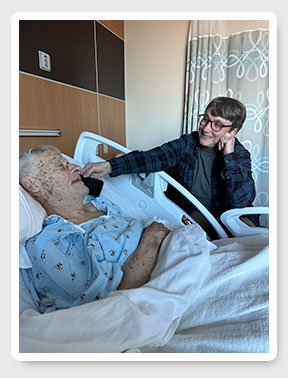 I heard your laugh as Beth and I entered the ward. That same sharp bark, cascading high to low. Softer though, ending with a wheeze. My shoulders eased at the sound of it.
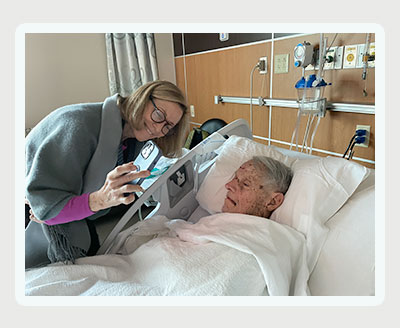 Conversation was challenging. What do you say to a man who doesn’t want to know he is dying? But also, your cognizance was markedly changed. Your speech was slurred and the words didn’t always make sense. You pointed out a circus parade on the ceiling. A marching band. Birds that talked to you. Vicky was coming soon with Rich, you said. Where should we go? Let’s go camping!
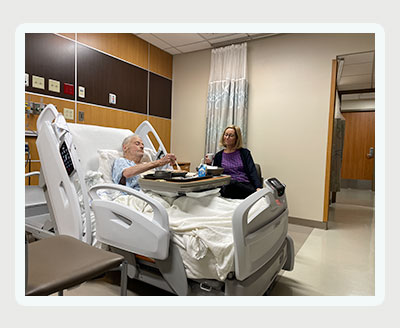 “Only the best for you, Dad.”
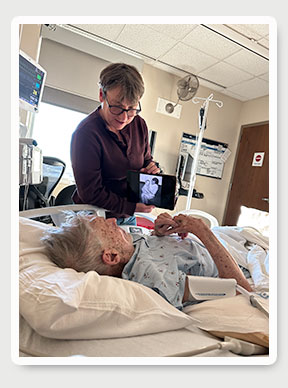 “Do you remember telling us stories about the mouse that lost his squeaker? Did you make those up?” You smiled and nodded. On the nights you didn’t have rehearsal, you always had more energy for us at bedtime than Mom did. Getting us glasses of water when we called for you. Even peanut butter sandwiches if we moaned with hunger. Tucking us in tight, one more time. We played you for the attention, one last kiss, and you never seemed to mind.
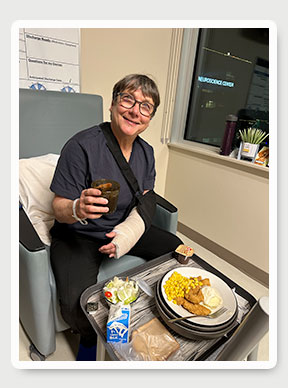 I’m sure you heard us that night. I was on painkillers. Beth had snuck in a small bottle of wine for herself. (“Only fair,” she’d said, and I agreed.) I had to ask for Beth’s help for everything. Cut up my meat, open my milk, put toothpaste on my brush, get off my clothes, my bra. When we were finally in our pajamas, reclined on the couch with our feet touching, I curled my toes around hers and smirked. “Jesus H. Christ!”
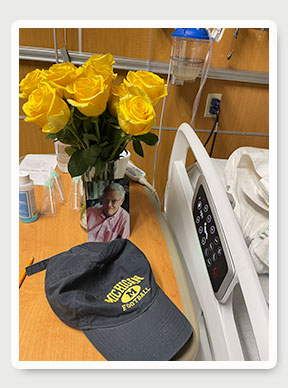 You needed to die, Dad, and you were missing your cue. I reminded you that Vicky and Rich were on the other side, waiting for you. I could almost hear you scoff. You had diligently raised us Catholic, but as soon as your devout father died, you never stepped foot in a church again. You didn’t believe in God or heaven. “But you don’t know,” I countered in my one-sided argument. “They could be there. Maybe you’ll get to see them.”
 We took our time to say goodbye. Held your cold hands, kissed your spotted forehead, smoothed your white hair, so thin now. Looking across your body into Beth’s eyes… I felt what she felt. She felt what I felt. It was the same complicated sorrow, braided with love. We knew each other’s tender spots. The disappointments, the hopeful joy. The shared memories of the fun-loving, affectionate father, who’d raised us to a good-enough point, then returned 30 years later when our own kids were too grown to care. Our hearts were bursting. With sadness, but also relief. And awe at what we had just experienced. This unreal week held a magic that only we would ever know.